
Home / Project Insights / Ashcroft Tenacity Paid Off For This Challenging Resource Consent Application
Ashcroft Tenacity Paid Off For This Challenging Resource Consent Application
Ashcroft’s Smarter Thinking Keeps Client’s Costs Down
The Ashcroft Subdivision and Planning team proved once again their expertise and commitment to getting resource consents and client projects over the line.
Our client had a large site that needed to be developed over two stages. Stage one involved building three new Ashcroft homes at the rear of the site while the existing house remained in place. Stage two involved removing the existing house and replacing it with a further four new Ashcroft homes.
Working smart to keep costs down.
To minimise costs, it was ideal if the access to the site and drainage that was set up for Stage one, could also be used in Stage two.
On the face of it, this didn’t initially look to be possible, especially if the front house remained.
- Council had recently installed pedestrian lights directly outside the property and as the road is on a main arterial road, this restricted where the site access could be located.
- There were a number of trees in the road berm which would make creating a site entrance difficult.
- Plus, the stormwater drainage was located on adjacent private property.
Addressing the challenges
The Ashcroft Planning and Subdivision team worked through how each of these obstacles could be overcome. Discussions were held with a Council Arborist who granted approval for removal of one of the berm trees, freeing up an entrance to the site. A traffic engineer was consulted and agreed the proposed site access entranceway was appropriate and safe in relation to the pedestrian crossing. The neighbour was also consulted and agreed to allow access and works on his property to connect drainage.
With all obstacles seemingly negated, a resource consent application was prepared for council. Unfortunately, council pushed back on the layout of the site, also expressing concerns with the vehicle crossing being in close proximity to the pedestrian crossing.
The Ashcroft team returned to council with more detail, showing the options they had initially considered, and then rejected, as they believed them to be less desirable options for all. Further analysis was provided to support Ashcroft’s proposed positioning for the vehicle crossing which demonstrated pedestrian safety would be maintained. It became clearer the original proposal was indeed the best for this site.
Success
With this new understanding, council were satisfied and Resource Consent was granted to another Ashcroft Homes new build project.
To date, the Ashcroft Subdivision and Planning team have secured Resource Consents for 100% of the projects they have applied for.
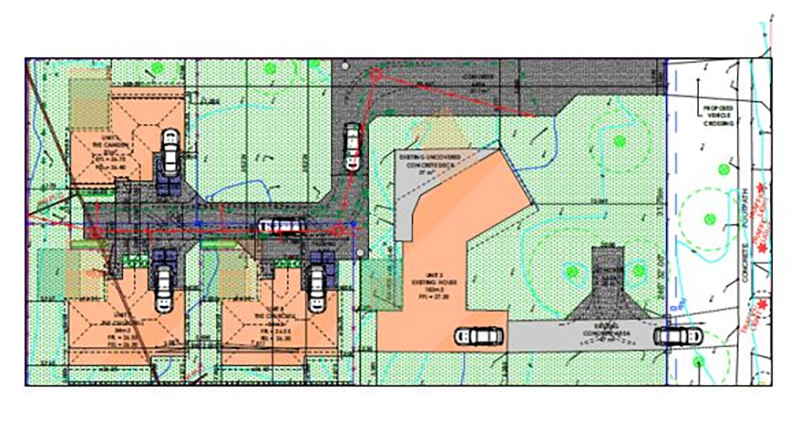
Stage 1
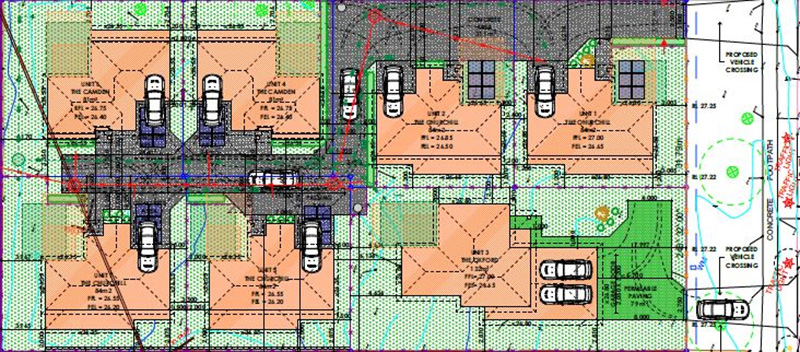
Stage 2
More Project Insights
Foresight and Resilience Brings Great Rewards for this Astute Developer
Our client purchased a duplex property in Otahuhu in 2013. While this was an ideal rental property, the site also had great development potential. Soon after purchase, our client approached the next door neighbour asking if they’d be willing to sell. They agreed.
Why This Developer Chose Ashcroft for Back-to-Back Projects
Our client, a seasoned property developer with extensive experience in residential projects, had worked with a wide range of builders, from group home companies to independent operators. After years of managing diverse teams, she recently completed her second project` with Ashcroft Homes.
Elevating Ground, Elevating Returns
Our client came across a great corner site which they knew would make an ideal development proposition. The site measured 746 sqm and was in a highly desirable, established Auckland suburb. The one drawback was that the site was not flat. The client initially considered the best development option would be to construct a new home and a new unit.